Research details
Crease Singularity
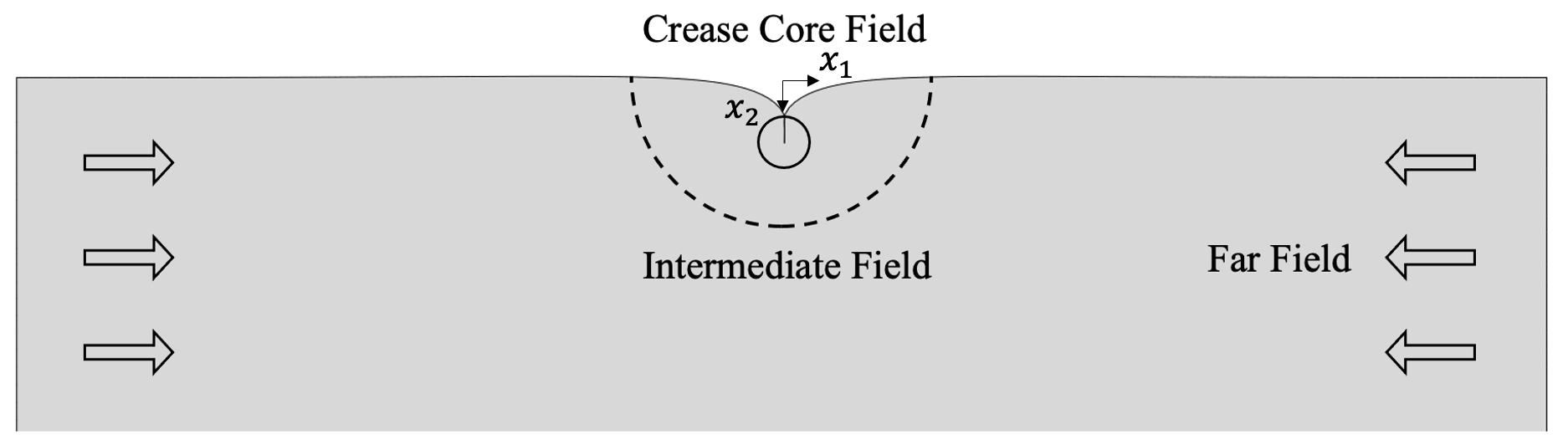
The configurational change of the material, such as the crack tip's propagation or the dislocation's motion, usually leads to a variation in the total energy. The change rate of the system potential is described either by the energy release rate or the energetic/configurational force (71, 72). The ruga pattern, such as wrinkles, creases, or ridges, is a deformation mode of the material surface. The configurational force controls their positions and phases.
The crease pattern is a localized deformation mode with significant deformation nonlinearity near the crease tip. Like the Peach-Koehler force acting on the dislocation, the crease is exerted by the thermodynamic driving force provided by the external compression stress and the image stress field of boundaries. Regardless of how the crease core is introduced, e.g., via the point force or the geometry defect, its growth is governed by the configurational force.
Orientation Localization of the Superlattice Composed of Host-Patch Nanoparticles
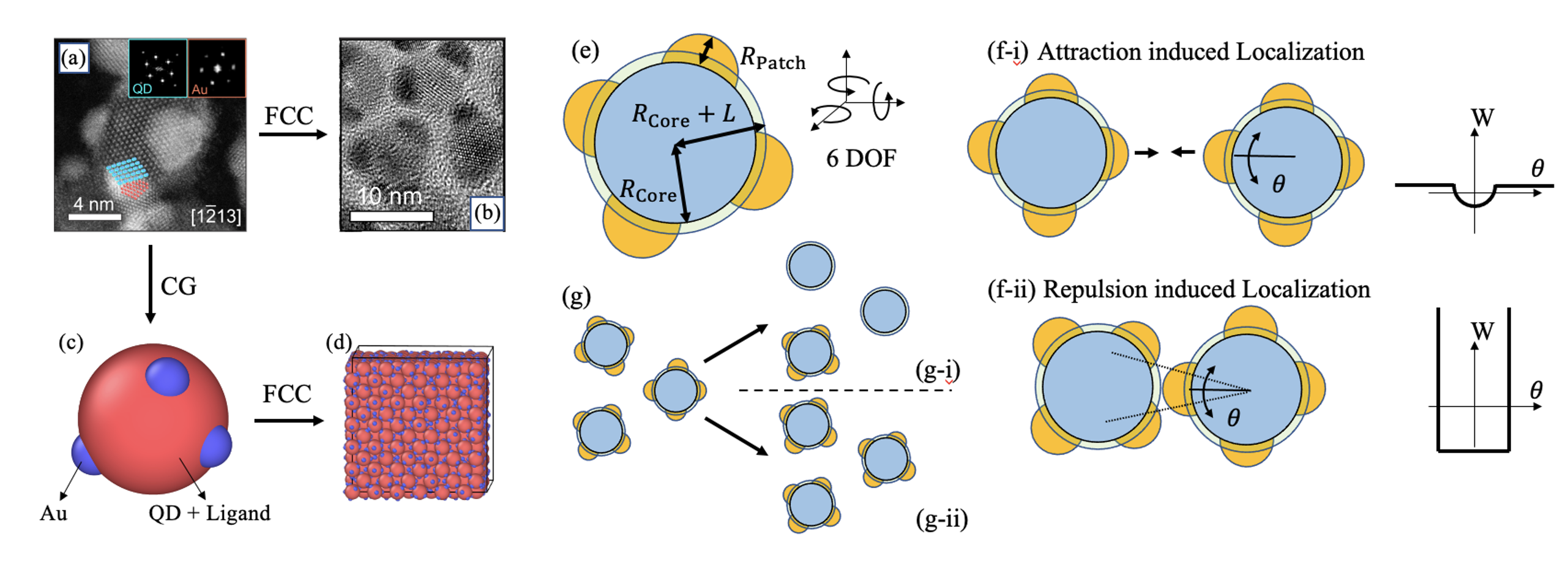
(To be filled)
Guided Alignment of the ssDNA along the nonuniform crinkle
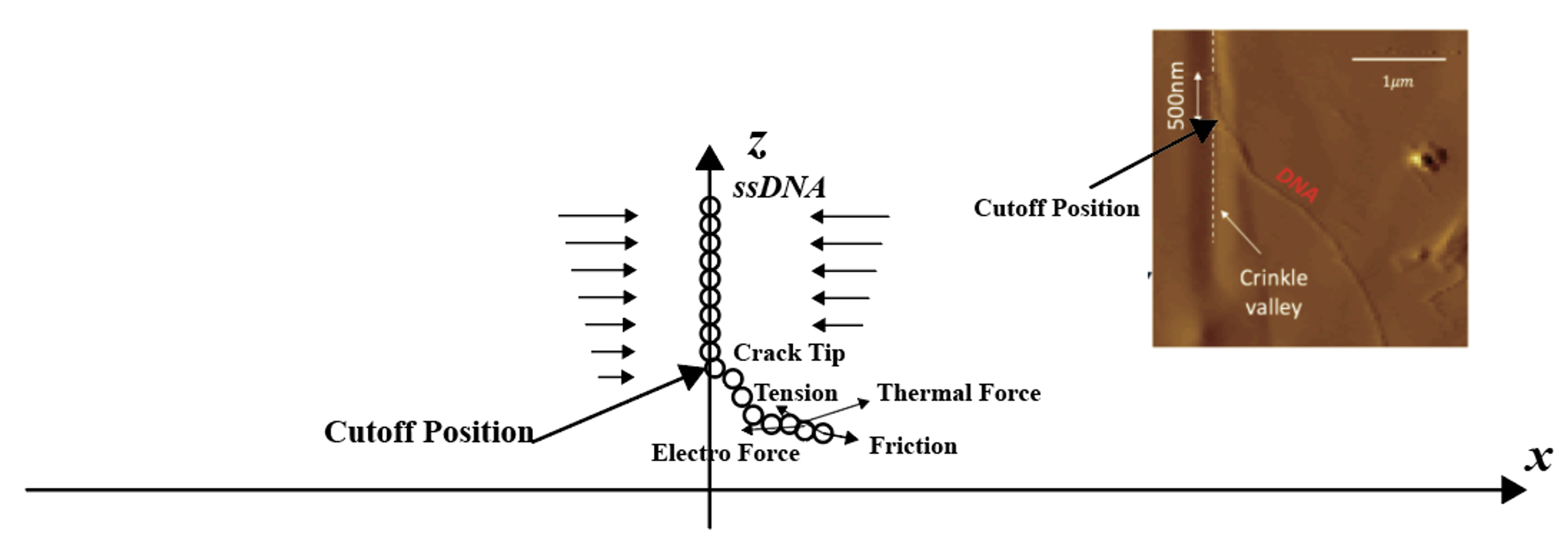
Our research presents findings on the linear alignment of single-strand DNA (ssDNA) with flexoelectric crinkles. Through molecular dynamic simulations of the curved ssDNA partially attached to the crinkles, it was determined that the adsorption rate is proportional to the crinkle strength. The non-uniform crinkles, which generate a potential gradient along their direction, were found to effectively guide the translocation of ssDNA. The higher crinkle strength gradient was also found to minimize the backsliding of the ssDNA during translocation. To create a substrate with these non-uniform crinkles, the authors designed a silicon wafer with an hourglass-shaped hole and transferred a CVD-MLG onto its surface. The deformation state of the CVD-MLG was then measured using Atomic Force Microscopy (AFM).